Why Is Pipeline Steel Used in Oil and Gas Pipelines?
Oil and gas pipelines operate under demanding conditions: high pressure, changing temperatures, soil movement, and long exposure to moisture. Pipeline Steel is used because suitable grades can combine strength, toughness, and weldability in a material designed for continuous service. The choice is practical, but not automatic.
The U.S. Energy Information Administration reports that the American natural-gas pipeline network spans roughly three million miles. This figure includes different pipeline types, not only long-distance transmission lines, but it shows the scale of infrastructure that depends on reliable pipe materials. At that scale, a small weakness can matter. Material selection, fabrication, inspection, and maintenance all contribute to safe performance.
Industry standards help turn material choices into measurable requirements. API Specification 5L sets requirements for line pipe used in pipeline transportation systems, including chemical composition, mechanical properties, testing, and delivery conditions. Engineers also consider diameter, wall thickness, operating pressure, temperature, and the transported product when selecting a grade. Strength alone is not enough. Toughness and weld quality matter, too.
Steel has limits. Corrosion, defects, and ground movement can still threaten a pipeline, even when the pipe meets a specification. That is why protective coatings, monitoring, and inspection remain essential parts of pipeline design and operation. The EIA’s network data and API’s technical standard offer useful context, but neither replaces project-specific engineering. The strongest case for Pipeline Steel is not that it eliminates risk. It provides a well-established, testable basis for managing it.
What Pipeline Steel Is and How It Is Made
Pipeline steel is a high-strength carbon or low-alloy steel made into pipe for transporting oil and gas. Its chemistry is carefully controlled: small additions of elements such as niobium or vanadium can help refine the grain structure and improve strength. The steel must also tolerate pressure, low temperatures, and flaws that could grow during service. A useful benchmark is API Specification 5L: its grade designations include X70, whose minimum yield strength is 70,000 psi. The grade alone, however, does not describe every property or prove a pipe is suitable for a specific route.
Manufacturing starts with a steel slab or billet, heated and rolled to achieve the required thickness and strength. For large-diameter line pipe, the plate is shaped into a cylinder and its seam is welded; seamless pipe is made by piercing and rolling a solid billet. Heat treatment and controlled cooling can adjust the finished steel’s properties. Each pipe is then inspected, with checks that may include weld examination and hydrostatic pressure testing. Small details matter.
The scale of steelmaking puts pipeline materials in context. World Steel Association’s World Steel in Figures 2024 reports 1,892.2 million tonnes of crude steel production worldwide in 2023. That figure covers all steel uses, not pipeline steel specifically. In practice, engineers select pipe grade, wall thickness, and manufacturing route together, based on operating pressure, temperature, and the gas or liquid being carried. It is easy to treat a grade label as a complete answer; it is not.
Why Is Pipeline Steel Used in Oil and Gas Pipelines?
Pipeline steel is engineered to carry oil and gas under pressure while withstanding demanding service conditions. It is made by refining and alloying steel, then forming it into pipe and testing it to meet specifications.
What the chart shows: Higher pipeline steel grades have higher specified minimum yield strength. Values shown are API 5L grade minima in megapascals (MPa); actual pipe properties depend on the applicable specification and product.
How Pipeline Steel Handles Oil and Gas Transport
Oil and gas pipelines face pressure, vibration, temperature shifts, and long periods of service. Pipeline steel is selected to carry these loads while remaining weldable into long, continuous lines. The American Petroleum Institute’s API Specification 5L sets minimum yield strengths by grade: X70 is 70,000 psi, while X80 is 80,000 psi. Stronger steel can support thinner walls in some designs, but grade alone does not determine a pipeline’s safe operating pressure.
The U.S. Energy Information Administration describes a natural gas network spanning more than three million miles of pipelines. That scale makes consistent material quality and careful joining essential. In service, steel’s strength helps resist internal pressure, while its toughness matters when temperatures fall or a flaw concentrates stress. Weld inspection and pressure testing help identify weaknesses before operation.
Small defects matter.
Steel still corrodes. Internal fluids may contain water or corrosive compounds, so operators use measures such as coatings and corrosion inhibitors. External coatings and cathodic protection help limit soil-related corrosion. These controls need monitoring; protection can weaken or miss a localized defect. Design also depends on wall thickness, diameter, terrain, and pressure cycling. It is tempting to treat a higher grade as a simple upgrade, but that overlooks weld performance and crack resistance. The steel is only one part of the system.
Properties That Support Pipeline Strength and Safety
Pipeline steel must withstand internal pressure, soil movement, temperature changes, and handling during installation. Its strength matters, but strength alone does not keep a pipe safe. The 46th edition of API Specification 5L lists a minimum yield strength of 485 MPa for Grade X70 steel. That figure helps engineers size pipe walls against expected pressure and loading. It is a minimum, not a guarantee of performance in every operating condition.
Toughness helps steel resist crack growth, especially in cold conditions or near welds. Ductility lets it deform to a degree before failure, while good weldability supports reliable field joints. API 5L sets requirements for steel grades, manufacturing, and testing; its PSL2 requirements include impact-toughness testing where applicable. DNV-ST-F101 also treats strength, fracture control, and fatigue as connected pipeline design checks. Small flaws matter.
Material selection still involves trade-offs. Higher-strength steel may allow thinner walls, but it does not remove the need for corrosion control, careful welding, or inspection. A real pipeline’s safety depends on its grade, wall thickness, weld quality, operating pressure, and ground conditions working together. That is easy to overlook. API’s grade data describe controlled test conditions, while field conditions can be less tidy.
Why Is Pipeline Steel Used in Oil and Gas Pipelines? — Properties That Support Pipeline Strength and Safety
| Property or design factor |
Typical value or characteristic |
How it supports pipeline strength and safety |
| Specified minimum yield strength (SMYS) |
API 5L pipe grades include Grade B at 245 MPa, X42 at 290 MPa, X52 at 360 MPa, X60 at 415 MPa, X65 at 448 MPa, and X70 at 483 MPa. |
Higher-strength grades can carry greater stress for a given pipe geometry. The selected grade and wall thickness must be determined by applicable design codes and operating conditions. |
| Strength-to-weight efficiency |
Pipeline steels combine high strength with a relatively compact wall section; actual pipe mass depends on diameter, wall thickness, and steel density. |
Can help limit material and transport requirements while meeting pressure-containment design needs. |
| Toughness and fracture resistance |
Impact toughness is assessed using specified tests, such as Charpy V-notch testing, when required by the applicable specification or project requirements. Acceptance criteria depend on pipe size, grade, temperature, and service. |
Appropriate toughness helps resist brittle fracture and supports control of crack initiation or propagation, particularly in cold conditions or demanding service. |
| Ductility and formability |
Pipeline steels are manufactured and tested to specified mechanical-property requirements; permissible elongation and other limits vary by grade and product form. |
Ductile behavior can help the pipe accommodate limited deformation without immediate brittle failure. It also supports forming and installation processes when performed within qualified limits. |
| Weldability |
Weldability depends on steel chemistry, carbon equivalent, thickness, grade, and welding procedure; welding must follow qualified procedures and inspection requirements. |
Reliable, inspectable welds allow pipeline sections to be joined into long continuous systems and help maintain structural integrity at joints. |
| Pressure-containment design |
Design pressure capacity depends on factors including pipe diameter, wall thickness, material strength, design factor, temperature, and applicable pipeline code. |
Engineers use these factors to select pipe dimensions and operating limits that provide an appropriate margin against yielding and failure. |
| Corrosion management |
Steel can corrode in the presence of water, oxygen, salts, or certain process fluids. External coatings, cathodic protection, corrosion control, and inspection may be used as appropriate. |
Managing corrosion helps limit wall loss and preserve the pipe’s pressure-containing capacity over its service life. |
| Quality control and traceability |
Pipeline specifications define requirements for manufacturing, testing, inspection, marking, and documentation. Requirements depend on the specified product standard and project. |
Documented testing and traceability help verify that pipe materials and manufacturing results meet the specified requirements. |
How Steel Grades Guide Pipeline Selection
Pipeline steel is selected by matching its grade to operating pressure, temperature, route, and fluid conditions. In common line-pipe specifications, grades such as X42, X52, and X65 indicate minimum yield strength, measured in thousands of pounds per square inch. Higher strength can allow a thinner wall for a given design, but it does not automatically make a pipeline safer or more suitable.
The grade is only one part of the decision. Engineers also consider toughness, weldability, wall thickness, and resistance to corrosion. A pipeline crossing cold, remote terrain may need steel with tested impact toughness, since brittle fracture can spread quickly. For corrosive service, material controls and protective measures matter alongside the grade. Small details matter. Pipe chemistry can affect how reliably field joints are welded, especially when weather and access complicate the work.
Selection should follow the project’s design code and verified test records, not a grade number alone. A higher grade may reduce steel weight, yet require tighter control of forming and welding. That trade-off deserves attention. A grade chart can look reassuring, but it cannot assess every site condition or inspect a weld. Engineers compare certified material properties with the pipeline’s actual loads and operating environment, then confirm that the chosen pipe meets the project specification.
Where Pipeline Steel Is Used in Oil and Gas Systems
Pipeline steel appears in several parts of an oil and gas system. Near wells, smaller gathering lines carry crude oil or natural gas from individual sites to collection facilities. These lines may cross uneven ground, so engineers consider pressure, soil conditions, temperature, and the loads placed on the pipe. Conditions vary. Steel’s strength and ability to be welded into long sections make it useful for these routes.
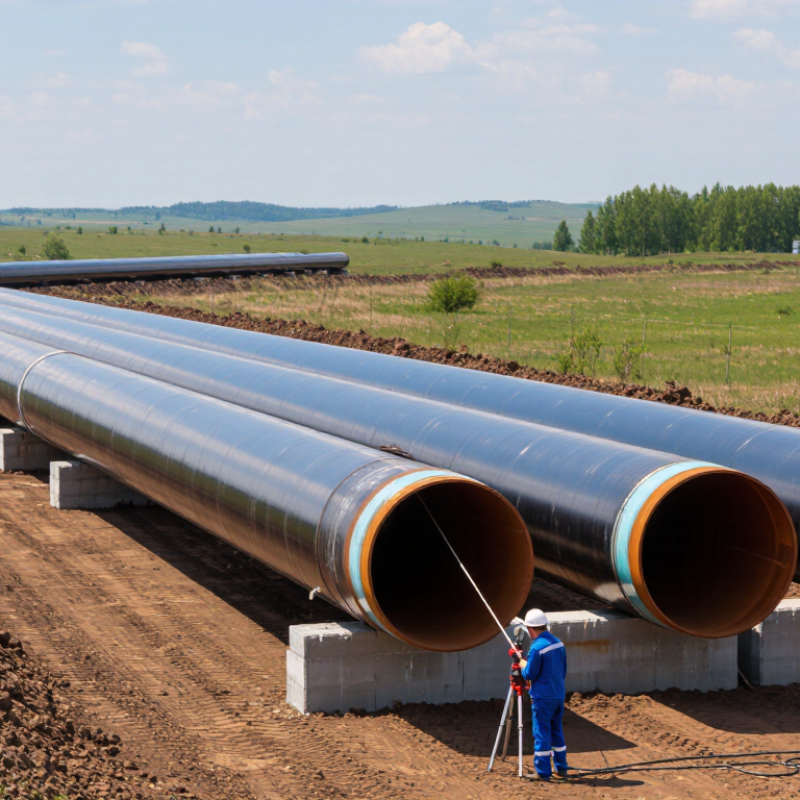
Larger transmission pipelines move product over long distances to terminals, refineries, or gas processing plants. At compressor and pumping stations, steel pipe connects equipment and carries the flow between pipeline sections. Offshore, specially designed steel pipes can run along the seabed or connect a platform to shore. Coatings and cathodic protection help limit corrosion, but they do not remove the need for inspection and maintenance. The right steel grade depends on the service, wall thickness, and operating conditions. There is no single choice for every route; local ground movement or changing temperatures can complicate even a well-planned installation.